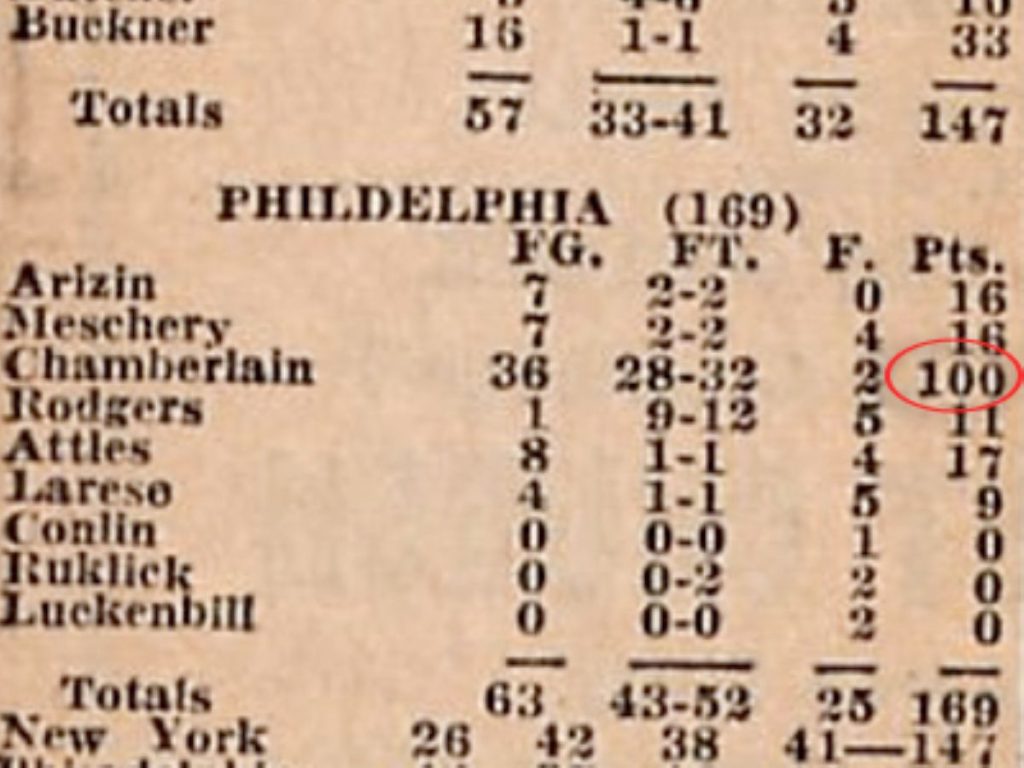
Chamberlain scored 100 points in a game against New York on Match 2, 1962 in Hershey, Pa.
There is no video proof that Wilt Chamberlain had the greatest performance in the history of professional basketball going back a century. Wilt Chamberlain established records in the 1960s that have not been challenged by Michael Jordan, Kobe Bryant and LeBron James. In 1961-62, the Philadelphia Warriors center averaged 50.4 per game. It was during that season on March 2nd, 1962 that the Big Dipper
did something no one has ever done in an NBA game.
Chamberlain scored 100 points as the Warriors beat the New York Knicks 169-147 in a neutral court game in Hershey, Pennsylvania.
Officially, only 4,124 people were in attendance.
There was no television, no ESPN or Fox or NBC or CBS or ABC or cable to record history and no radio reporters to get post-game reaction. Just a number of newspaper people to record it. In fact, the local Hershey/Harrisburg, Pennsylvania television stations did not even bother to send a film crew or a reporter to the arena. The game was no big deal for people in Central Pennsylvania. Eddie Gottlieb’s Philadelphia Warriors played wherever the team could find a court like the other NBA teams in those days.
Chamberlain made 36 of 63 from the floor that night and was a remarkable 28 of 32 from the free throw line. Chamberlain was not a good
foul shooter. In his career he made about 51 percent of his foul shots. Two weeks before, in a game against the St.
Louis Hawks, Chamberlain attempted 34 free throws. Teams fouled him thinking it was better to let him try and score from the line than the floor.
Richie Guerin led the Knicks that night with 39 points and claimed for years that the Warriors were more intent to give the ball to
Wilt than play basketball.
Guerin’s comments upset Chamberlain for many years. “I think Richie has it a little bit backwards. His team did not want to see me
score all of those points and they were not playing basketball.”
“We were playing the game of basketball. I was averaging 50 points a game that year, so it was normal for me to score a lot of points. That was the normal way for us to play that year. So it wasn’t anything out of the ordinary.”
“Only when they decided that they did not want me to score anymore points that my team decided to do just the opposite.”
The “opposite” was to get the ball into Wilt who was being guarded by Darrell Imhoff. The argument can probably go either way, did the Warriors go exclusively to Wilt or were the Knicks just trying to foul him to stop him?
Chamberlain’s quarterly numbers that night were good enough for a stalwart 48 minute performance by any other player. Chamberlain scored 23 in the first, had 10 rebounds and was 9-9 from the foul line In the second period, he had “only” 18. In the third quarter, Wilt scored 28 and had six rebounds and in the final stanza, Chamberlain was 12 of 21 from the floor and made seven of
10 from the foul line. Chamberlain pulled down 25 rebounds and also had two assists. Imhoff scored seven.
“It was a tremendous feat and I don’t think it will ever be duplicated again,” said Johnny Green who started at forward that night for the Knicks. “We were there trying to prevent Wilt from scoring as many points as he did.
“But, if you remember, Wilt averaged 50 points a game and he did this missing 15, 20 or 25 foul shots a game.
“People started whispering around the league, if Wilt ever made his foul shots he could score 100 in one game. We knew, if he makes the
foul shots, he’d score a phenomenal of points. It was just a matter of time for him before he got all of those points.”
Green was of the opinion that the Warriors were looking for Wilt to score once the third period got going, confirming Guerin’s theory.
Alvin Attles was the shooting guard on that Warriors team. In fact, Attles sort of holds a record from that game. He and Chamberlain
combined to score 117, the record for the most points by two teammates. Attles also said Guerin was wrong, the Warriors weren’t going out of their way to feed Wilt. At least not to the fourth quarter.
“The most important thing about that game was we won, and two, Wilt scored the 100,” Attles explained. “And if you look at the box
score, everybody got their scoring average for the year. Tom Meschery got 16, Paul Arizin got 16. Only Guy Rodgers didn’t hit for his average (actually Rogers scored 11, his average was 8 points per game). There were a lot of points scored. We scored 167 points, so we got our averages.”
Attles said he was unaware of just how many points Chamberlain had until the fourth quarter when the Public Address announcer Dave Zinkoff started to say Chamberlain now has 80 points or 82 points. However, he claimed it was not until that point in the fourth quarter that the Warriors thought the center had a chance at 100 points.
“The key for him in getting the 100 points was hitting 28 free throws. You know it’s really interesting and there is a lot of conjecture about what really happened. If you go back and look at the statistics, we were actually below our foul average that night for the season. We did not intentionally foul that night to get back the ball and give Wilt his shots until late in the game,” he said defending the Warriors strategy. “It as a tremendous feat.”
Green thought Chamberlain received his teammates’ full assistance earlier than when Zinkoff announced Chamberlain score his 80th point
which broke the old mark of 78 that the Big Dipper set three months earlier in a triple overtime game against Los Angeles. Wilt also scored
73 against the Chicago Packers on January 13th, 1962.
“Well, I think it was after halftime and once we got into the third quarter and he really got into his game. His teammate was the
playmaker Guy Rodgers and they were started to look for him more and more. I think he had 50 or so at the half. (Chamberlain had 41)
“They looked for Wilt anyway,” Green remembered. “I just think they started to look for him more by the end of the third quarter and
into the fourth. He was really scoring.
“And we started to play only Wilt by the end of the third quarter not the Warriors. We went into the game playing the Warriors but
we ended up playing Wilt because he was the real warrior.
“That entire year, he was awesome. We didn’t realize it while we were playing him that night but sitting in the stands watching him, you
probably realized just how awesome he was.”
“I don’t think you will see that again and I don’t think you will see anyone averaging 50 points per game either. I wish somebody would
have taped the game. But we were in Hershey, not Madison Square Garden or the Convention Center where the Warriors played.”
Chamberlain said he knew he was on course to score 100 points. The fans wanted him to score the 100 points. He wanted it as well.
The 99th and 100th points came with: 46 seconds left when he received a pass from Joe Ruklick and hit a basketball. Ruklick was
scoreless that night but that pass assured him of a spot in basketball history. Ruklick had just 14 assists all season.
Chamberlain set records in points scored with 100. Most field goals attempted in a half with 37 in the second half, most field goals
attempted with 63 and the most field goals attempted in a quarter with 21 in the final period. He set records for most field goals made with 36 and the most field goals in a half with 22 in the second half and most points in a half, 59, in the second half. All of the evidence
suggesting that the Warriors were looking for him.
That season he set records in most field goals for a season with 1,597. Chamberlain had 45 games with 50 or more points (in an 80 game
season) and twice had 14 game streaks of 40 or more points. Jordan once scored 40 or more points in nine straight games. Between October 19th, 1961 and January 19th, 1963, Chamberlain scored 20 or more points in 126
straight games, an NBA record. He never fouled out either and in his career averaged 45.8 minutes a game on the court.
Still, the Warriors were only 49-31 that year and were knocked out of the playoffs by Bill Russell, Bob Cousy and the rest of the Boston
Celtics in the seventh game of the Eastern Conference Final. Boston didn’t have the ultimate scorer like Wilt and Wilt didn’t have the cast
of Hall of Famers like Tom Heinsohn, Sam Jones, K. C. Jones and Cousy around him in Philadelphia.
“The Knicks lost perspective on winning the game,” Chamberlain said. “Remember, we won the game. That is the idea of basketball, to go
out and win.”
“They were more concerned with stopping me from scoring points than winning the game. It wasn’t the greatest shooting night I ever had, but it’s the game I’m most remembered for.”
Despite Wilt and a very good cast surrounding him, the Philadelphia Warriors never won an NBA title. Gottlieb a few months later would sell his Philadelphia Warriors to San Francisco investors for $850,000 and the team headed west. Philadelphia was without an NBA team in 1962-63. The NBA really didn’t have a national TV contract either in 1962-63. But Wilt did score 100 one night back in an era where the NBA was at best a mom and pop store operation.
From the ebook “Peach Baskets to Dance Halls and the Not-so-Stern NBA” available at iTunes, NOOK and other estores.